

by Stefan Korshak | May 23, 2025, 7:50 pm
Besides hitting missile production and energy facilities Kyiv’s unmanned aircraft have killed mobile internet for dozens of Russian cities and towns and stranded tens of thousands of air travelers.
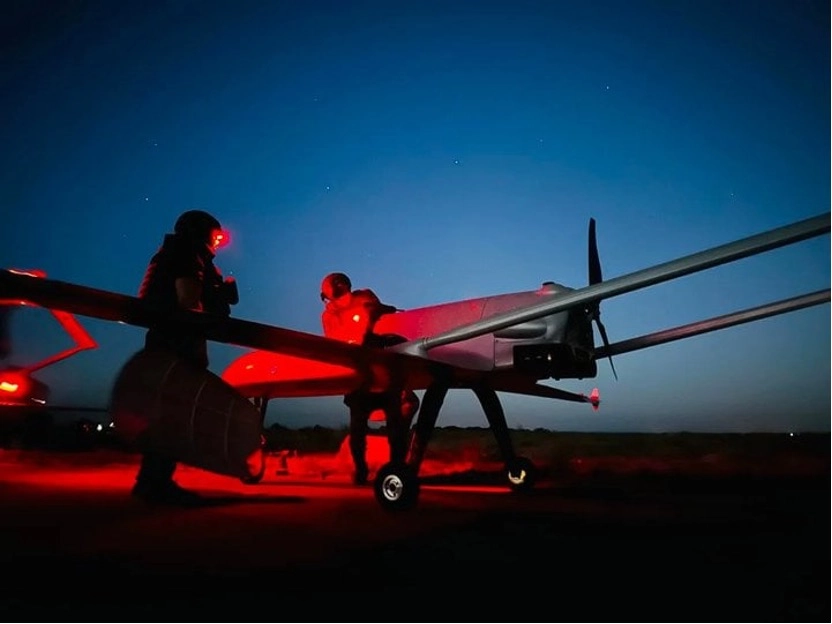
source: click on picture
Popular Russian mil-blogger Ilya Tumanov, a former attack jet pilot and unofficial Russian Air Force spokesman told his more than 600,000 followers that: “Air traffic is partially or completely paralyzed… mobile Internet is disconnected… the drones that fly are quite enough to stop the airports in Moscow from working and overload the airports of neighboring cities and therefore partially block them.”
Russia probably still holds the single day record for strikes involving a reported 273 drones launched against Ukraine on Sunday followed by a further 112 on Monday, and 118 the next day. About half of the total of Russian UAVs involved were decoys, with the main targets being Ukrainian energy infrastructure and civilian homes and businesses, according to data published by Ukraine’s Air Force showed.
The pace of Ukrainian long-range attacks on Russia during the last three days represents around a 23% increase in intensity compared with Russia’s May 18-20 surge – and it may not be over. Kyiv Post’s researchers suggest.
campaign
Over the last 72 hours Ukraine’s armed forces set a new record since Russia’s war on Ukraine began of the numbers of long-range drone strikes carried out – for either side.
Since Wednesday more than 750 explosive-carrying unmanned aerial vehicles (UAV) were dispatched from Ukraine-controlled territory to attack targets across western Russia. Some Ukrainian drones safely transited more than 800 kilometers (500 miles) of Russian air space – distances comparable to Milan-Berlin or London-Zurich – before their terminal attack phase.
The independent Astra news agency citing military sources on Friday morning said that between May 20-23 May a total 756 Ukrainian drones had penetrated Russian air space. “Temporary” suspensions of civilian airline operations were put into effect on Friday, in Vladimir, Kaluga, Kostroma, Tambov, Yaroslavl, Ivanovo, Samara and Nizhny Novgorod, as well at Moscow’s Vnukovo, Domodedovo, Sheremetyevo and Zhukovsky airports.
Since Wednesday more than 750 explosive-carrying unmanned aerial vehicles (UAV) were dispatched from Ukraine-controlled territory to attack targets across western Russia. Some Ukrainian drones safely transited more than 800 kilometers (500 miles) of Russian air space – distances comparable to Milan-Berlin or London-Zurich – before their terminal attack phase.
The independent Astra news agency citing military sources on Friday morning said that between May 20-23 May a total 756 Ukrainian drones had penetrated Russian air space. “Temporary” suspensions of civilian airline operations were put into effect on Friday, in Vladimir, Kaluga, Kostroma, Tambov, Yaroslavl, Ivanovo, Samara and Nizhny Novgorod, as well at Moscow’s Vnukovo, Domodedovo, Sheremetyevo and Zhukovsky airports.
Mobile internet shut downs were in effect in the cities of Tula, Lipetsk, Voronezh, Vladimir, Oryol and Ivanovo regions, the report said.
Popular Russian mil-blogger Ilya Tumanov, a former attack jet pilot and unofficial Russian Air Force spokesman told his more than 600,000 followers that: “Air traffic is partially or completely paralyzed… mobile Internet is disconnected… the drones that fly are quite enough to stop the airports in Moscow from working and overload the airports of neighboring cities and therefore partially block them.”
campaign
Ukraine’s latest drone strikes have been wider reaching, more complex and more ambitious than any previous air raid campaign. Both sides consider damage caused by such strikes to be a military secret, but open sources indicated that over the five-day period of May 19-23 Ukraine has hit and damaged at least four and as many as ten major targets inside Russia.
The Ukrainian drone swarms and security measures ordered by the Kremlin in response have, in addition, disrupted both internet access and air travel across south-west and central Russia, an area bigger than France and home to about a quarter of the Russian Federation’s 144 million citizens.
A precursor strike may have taken place early on Monday when Ukrainian sea and air drones attacked an abandoned drilling rig in the Azov Sea manned by Russian security and air defense troops. Ukraine’s state security service the SBU later took credit for what it called a combined attack that destroyed a Neva air defense radar set up on one of the drilling rig towers along with destruction of crew quarters and storage containers on the platform.
The BPSD factory manufactures communication, control, electronic warfare (EW) systems and simulators for tanks and missile system for the Russian military. Its products primarily using smuggled western electronic components for weapons like Russia’s T-72B3 andT-90M tanks, self-propelled howitzers, the Iskander ballistic and Kh-101 missiles, and for military communication systems.
Detonations were heard and seen at the factory premises between midnight and according to Russian Defense Ministry counts, 5:30. Local social media reported hearing 11 explosions. The Ukrainian military claimed ten hits and a big fire.
Ukraine appears to have attempted to overwhelm air defense by sending dozens of drones into air space across western Russia. Russia’s Defense Minister claimed it had shot down a total 127 Ukrainian drones over Russia’s Bryansk, Oryol, Kursk, Moscow, Vladimir, Ryazan, Belgorod, Tula and Kaluga regions, and over the Black Sea.
Overnight Wednesday-Thursday more than 200 Ukrainian drones were launched towards Russia had two probable main targets: the NPO Basalt arms manufacturer in Tula, and an oil refinery in Ryzan, one of Russia’s largest operated by the energy giant Rosneft. Ukrainian drones had hit both sites in the past. Basalt, a manufacturer of rocket and missile components, flame thrower technologies, and munitions, was attacked on May 7 and 16.
Fires and explosions were reported at both locations. The airport lockdowns were wider than on Wednesday and thousands of air travelers were stranded in Moscow airports for much of the day. The independent news agency Astra and even Russian state-controlled media reported giant queues, packed terminals and flight delays of six hours or more.
Overnight Thursday-Friday at least 150 and possibly more than 200 Ukrainian drones flew into Russia, based on local and official reports, with final counts still in progress as this article was published. At least two main targets were apparent:
There were reports that the internationally sanctioned Energiya company, in the city of Yelets, in the Lipetsk region, was struck multiple times, damaging buildings, setting fires, and forcing evacuations. The facility manufactures military batteries and components for ballistic missiles.
Official Russian sources said air defenses spotted Ukrainian drones operating over 15 of Russia’s western regions including Moscow, and occupied Crimea with multiple shoot downs in all locations. Travelers’ social media confirmed air defense systems firing on incoming drones at the Ivanovo airport to the east of Moscow, airport lockdowns, and mobile data shutdowns in dozens of cities and towns overflown by the Ukrainian drones.
The NASA-run FIRMS world fire watch satellite network showed no active blazes at the Yelets Energiya facility at midday (Kyiv time) on Friday. A massive fire, apparently burning for more than 24 hours, was visibly still in progress in the vicinity of the Basalt plant in Tula.
No comments:
Post a Comment